


Índice
To manage the pressure at the start of a golf tournament concentrates like at no other moment of the round. Absolute silence, eyes watching, a blank scorecard and the feeling that everything begins, and is judged, in a single swing. Hole 1 is not usually the most technically difficult, but it is psychologically the most demanding. Knowing how to manage that first shot makes the difference between starting in control or dragging tension for several holes.
At Golf Alcanada, where competition is lived with intensity and respect for the game, mastering this moment is a real competitive advantage.
Hole 1 at Alcanada: why it is special
The start at Alcanada has something unique. From the tee of hole 1, the lighthouse appears over the bay of Alcudia and the Mediterranean accompanies every breath. It is an inspiring image, and, if you are not prepared, also an intimidating one.
The design invites patience: this is not about impressing with a monumental shot, but about putting the ball in play and understanding that you have 18 holes to build your result.
Understand what pressure is
Pressure on the first tee is not fear of failure; it is expectation.
- Expectation to start well.
- Expectation not to disappoint.
- Expectation to prove your level.
Accepting this activation frees you from fighting it. The goal is not to eliminate nerves, but to channel them and turn them into useful energy.
Arrive early: warm-up is your anchor

Players who best manage hole 1 share one habit: they never improvise their preparation. Arrive with enough time to enter “competition mode” gradually:
- Progressive stretching.
- Practice shots starting with wedges.
- 10–15 putts from different distances.
- Repeating your full pre-shot routine several times.
This ritual prepares the body and, above all, organises the mind before the key moment.
Simplify the goal: the 80% strategy
On the tee of hole 1, forget about the perfect shot. Define a simple, controllable objective:
- Good rhythm.
- Solid contact.
- Clear line.
Using around 80% of your power reduces muscle tension, makes the swing more repeatable and minimises serious mistakes.
Choose the most reliable club, not the longest

On the first tournament shot, the ego often asks for the driver. The mind does not always agree.
- If your wood or hybrid is more reliable, use it.
- Less distance with more control is a psychological win.
- The fairway does not ask which club you used.
Starting with the ball in play immediately reduces pressure.
Breathe to stabilise the body
Breathing is the most immediate tool against nerves. Spend a few seconds breathing consciously before your routine. You will notice your heart rate drop and sensitivity return to your hands and arms.
Rely on your routine as an anchor
When everything feels different, your routine must be identical:
- Same pre-shot sequence.
- Same number of practice swings.
- Same tempo when setting up.
Routine turns an exceptional moment into a familiar one.
Manage time
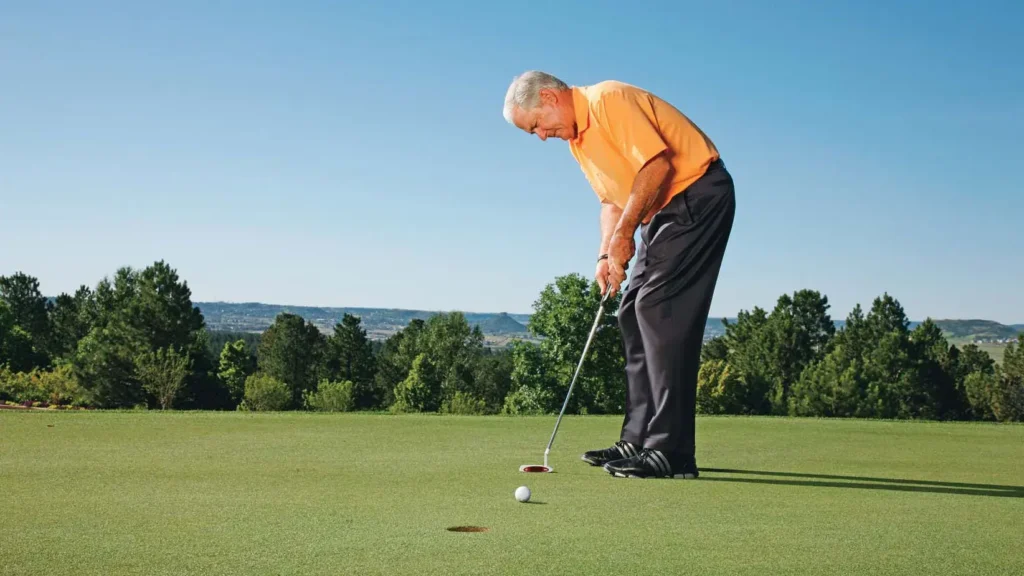
Pressure distorts time perception: some players rush, others freeze. Respect your usual pace. If you doubt, take one more breath and execute. Do not negotiate with yourself at the last second.
Visualise the sufficient shot, not the perfect one
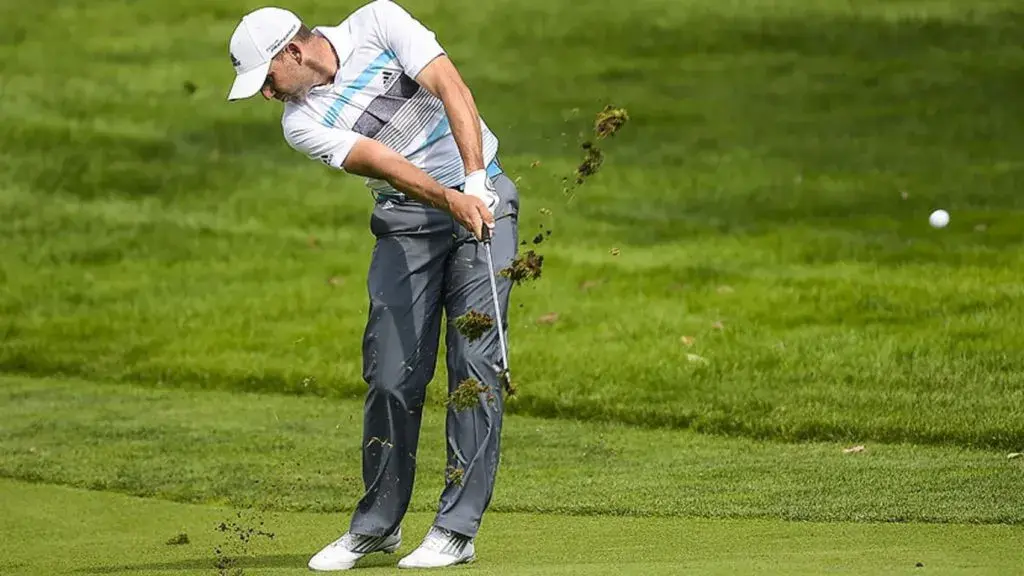
Do not visualise the ideal shot; visualise the functional shot:
- Comfortable trajectory.
- Wide landing area.
- Predictable flight.
Simple visualisation reduces demand and improves execution.
Accept any outcome and move on
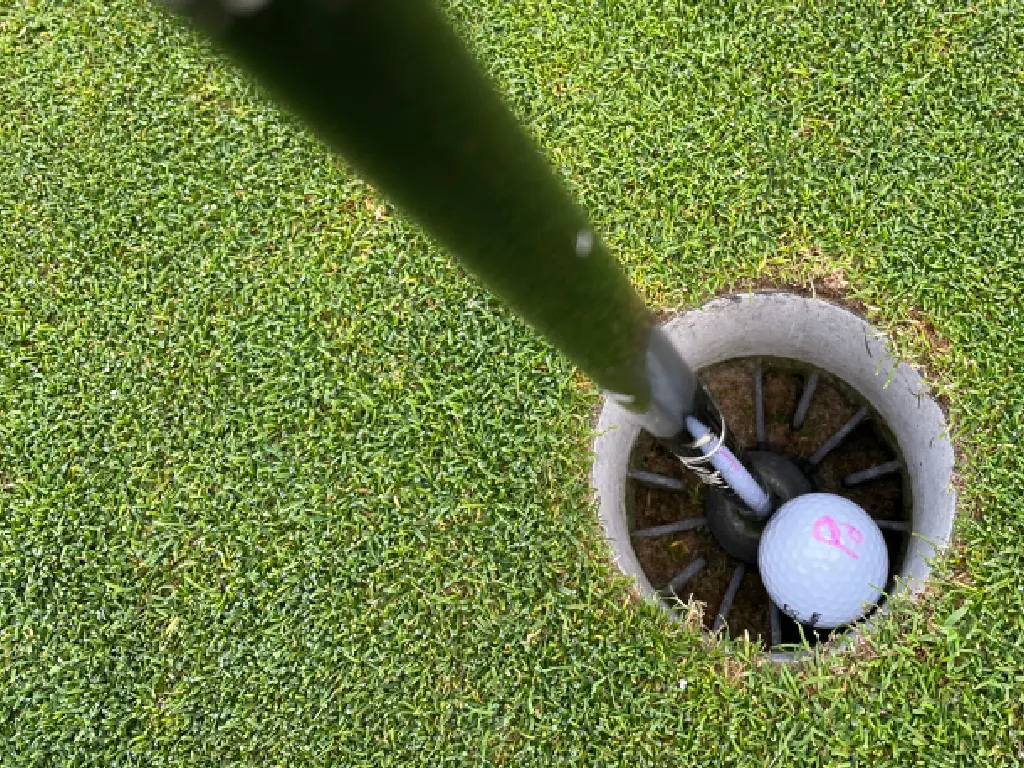
Even when you do everything right, the result may not be perfect.
- A playable rough is not a disaster.
- An early bogey does not define the tournament.
True pressure management is measured on the second shot, not the first.
Frequently asked questions
Is it normal to feel more nervous on the tee of hole 1 than later in the round?
Absolutely. This is known as “first tee jitters.” Psychologically, Hole 1 represents the transition from a controlled environment (the range) to the reality of external judgment. Your brain interprets the silence and the audience as a threat to your competitive status. Even pros feel this adrenaline spike; the difference is they view it as “ready-to-use energy” rather than fear of failure.
Does pressure decrease with tournament experience?
Pressure is a biological constant, but your perception of it changes. With experience, you stop seeing nerves as an obstacle and start seeing them as a sign that the tournament matters to you. Veteran players don’t “feel less”; they simply have better management tools: solid routines, diaphragmatic breathing, and internal dialogue that prioritizes the process over the result.
Should strategy change on hole 1 compared to a casual round?
In competition, strategy should shift toward risk management. While you might be aggressive in a social round, the goal on the 1st tee in a tournament is simply to “put the ball in play.” It is recommended to aim for the widest targets and choose clubs that give you 80% confidence, even if you sacrifice distance. Success on the first hole is measured in emotional control, not yards.
What if I miss the first shot and pressure increases?
The most important thing is to avoid the “cascading effect,” where one mistake leads to a risky decision to compensate. Apply the 10-second rule: allow yourself to be frustrated while walking toward the ball, but once you reach it, the past no longer exists. Redefine success for the hole: if your goal was par, perhaps now it’s a “smart bogey” that keeps your scorecard safe from a major disaster.
Is it better to always use the same club on the first tee?
Consistency is the antidote to anxiety. Using the club you feel most comfortable with triggers a confidence response in the nervous system. If your driver is erratic but your 3-wood is solid, the 3-wood is the right choice. The goal is to reinforce the belief that you are in control of your start; there will be plenty of time for longer clubs once your body has warmed up.
Does the pre-shot routine really help with nerves?
The routine is your mental anchor. When the environment is chaotic or stressful, the routine is the only thing you can control 100%. By repeating the exact same steps, you send a signal to your brain that you are in a familiar and safe environment. This lowers your heart rate and allows the technical movement to be fluid and automatic.
Can a bad start ruin the whole tournament?
Absolutely not, unless you allow it to. Many players fall into the mental trap of believing their “momentum” is broken. However, golf history is full of under-par rounds that started with bogeys. A bad start is just a statistical data point, not a prediction of the future. Resilienc, the ability to return to the present after a failed shot, is what separates winners from the rest of the field.
At Golf Alcanada, pressure is a natural part of competitive golf. The environment, tournament organisation and practice areas are designed to help you compete with clarity, not tension. Working on routine, decision-making and mental management is as important as the swing itself.
If you are interested in practicing on our fields, please feel free to contact us through our website.
Doglegs reward strategy as much as precision. Learn how to read the hole, choose the right club, shape fades and draws, and manage risk to take advantage of every bend.
How to play golf intelligently in windy conditions, reducing errors and improving decision-making on open and exposed courses.
Discover why strategic decision-making and terrain adaptation are your best allies for conquering Mallorca’s finest golf course.
The Balearic Golf Federation Celebrates the 2025 Awards in Palma Nearly 300 attendees at an evening of recognition, season review, and institutional tribute Palma, Friday, January 16, 2026 – The Balearic Golf Federation held its 2025 Golf Awards gala last night, Thursday, January 15, at the Palma Congress Palace. The event brought together nearly 300…
With the right adjustments, sea fog can become an ally instead of a challenge on the course.
Discover how to limit damage and recover intelligently after a poor tee shot at Golf Alcanada
